Showing posts with label Faith. Show all posts

Tuesday, 12 May 2015

The Global Learning Newsletter: May 2015


Welcome! Global Learning has been keeping busy this last month, as we get set to release our new and improved website in June.  Stay tuned for this exciting launch. We’d also like to extend a warm thank you to our valued strategic partner CAMSC, for including Global Learning in their annual Procurement Fair. 

To read, download, or share the May 2015 Global Learning Newsletter - click here.

Should you have any difficulty accessing the newsletter, contact info@egloballearning.com, and we can email you a pdf version.  - Thank you !

Thursday, 16 April 2015

When Divided, We are Conquered

Our societies are structured around the concept of “betterment”.   Most of us operate with an innate belief “If we make things better now, they will flourish later.”  It’s why we have things like schools, libraries, gyms, AA, and most importantly, our community laws.

But what happens when each of our own individualized ideas of what “better” is, is drastically different? Is better to you, more beautiful, more sustainable, more respectful, or perhaps more holy?

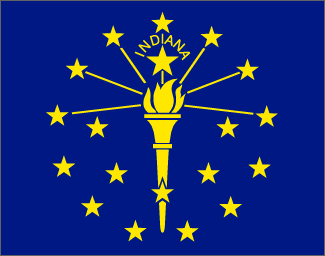
That’s the question at hand when it comes to such laws as Indiana’s
SB101 – The Religious Freedom Restoration Act.  Indiana’s SB101 – The Religious Freedom Restoration Act, signed into law by Gov. Mike Pence on March 26th, allows individuals and companies to assert that their exercise of religion has been, or is likely to be, substantially burdened as a defense in legal proceedings.  This opens the door for business owners to choose who they will or will not accept patronage from based on their religious belief, without fear of being held liable for discrimination.

What differentiates this law from a similar federal law, The Religious Freedom Restoration Act of 1993, as well as several other state laws, are a few key points:

• Indiana’s Law Applies to Companies; Others Do Not
• In Some Other States, Non-discrimination Laws Trump ‘Religious Freedom’ Laws
• The Political Context is Different, and so are the Policy Aims.
• The Indiana Law Applies to Private Disputes

You can find a great breakdown of these points from ABCnews.com.

As expected, the situation brought to the forefront, the many times (but not all the time) contentious cross sections of the LGBT and Religious communities. Of primary concern was that now any business, could deny service to an LGBT person, and claim they had the right to do so while not being held liable for discrimination on the basis that they were just upholding the demands of their faith.

Thrust into the spotlight was a small Indiana pizzeria, who when pressed, claimed they would decline a client if they were asked to cater a same-sex wedding reception citing their Christian beliefs.  I will make note that they did mention, that they would serve all customers regardless of orientation, but that they drew their professional line at catering same-sex wedding receptions….with pizzas.
After wide spread media coverage, the pizzeria closed its doors to bide it’s time while the media frenzy passed.

Now I’m not one to support the demise of anyone or their business, but I must be honest that I had a moment of “Yay! The “good guy” won!”. It restored a bit of my faith in humanity, that can so easily get chipped away when you hear that there are still people in North America, who think the best option is promote segregation.

However, that’s when the reality of North America’s current state of inclusion started to set in. Within weeks upon closing, a crowdfunding campaign was launched to help support the establishment’s owners, during their “time of need”.  Quickly, the campaign raised over $800,000.

With the money, the pizzeria has been reopened, and the owners have indicated their plans to donate portions of the raised funds to various charities of their choosing.  As you can assume, the donated money came from SB101 supporters; those who feel they have the right to not be held liable should they opt to deny service to someone based on their sexual orientation or gender identity.

Let me just summarize: over $800,000, was crowdfunded in support of legal segregation.

The backlash from Indiana’s SB 101 was immediately felt by the entire state, when such organizations as SalesForce, Angie’s List, a multitude of municipalities, and a growing list of other organizations, opted to cease all interactions with the state, should they continue with SB 101 on the books.  While Gov. Mike Pence, consistently claimed the bill was about bringing communities together, Indiana Republicans announced an agreement that will alter Indiana’s controversial Religious Freedom Reformation Act to ensure that it does not discriminate against LGBT people. The proposed change grants new protections for LGBT customers, employees and tenants.

When we create laws, our sincerest efforts and focus should always be to empower an entire community; while ensuring civility and sustainability. When we create laws that leave open the door for legal segregation, we are purposefully un-leveling the playing field, and intentionally causing civil discourse, with the goal of leaving fellow community members un- or minimally sustainable. Which brings me back to the concept of betterment.

My betterment is creating a space where all views have the opportunity to be presented, where taking pride in your belief system and living your personal life accordingly is acceptable.  My version of betterment, however, does not include creating tools with a direct aim at dividing us. We should have realized a long time ago that we are all in this together. Anytime we stray from that thinking as a global community, we are only making things better on an emotionally local level.  And that is how and why people often confuse diversity for division.....



Tuesday, 11 December 2012

Hanukkah: Illuminating the Festival of Lights


From December 8th to December 16th, 2012, our community members of the Jewish faith will celebrate Hanukkah. Also known as the Festival of Lights, Hanukkah is observed for eight nights and days to commemorate the rededication of the Holy Temple in Jerusalem. At the heart of the festival is the nightly menorah (candelabrum) lighting: a single flame on the first night, two on the second evening, and so on till the eighth night of Hanukkah, when all eight lights are kindled.

In the 2nd century BCE, Judaism was outlawed by the Greek monarch, Antiochus IV Epiphanes, and he had an altar to Zeus placed in the Temple. This provoked a large-scale revolt, first led by Mattityahu, a Jewish priest, and completed by his son, Judah. The Temple was liberated and rededicated, and the festival of Hanukkah was implemented to celebrate this event.

According to the Talmud, olive oil-fuelled the menorah in the Temple, and enough was required to burn through the night every night. Traditionally, the story tells that there was only enough oil for one day; yet the flames burned for eight days, the time needed to prepare a fresh supply of oil for the menorah. The eight-day festival was created by the Jewish sages to commemorate this believed miracle. While lighting the prominently displayed menorah, Jews typically recite blessings to remind others of the miracle that inspired the holiday.

The hymn “Ma’oz Tzur”, based on a Jewish liturgical poem, is sung after the lighting of the festival lights, and is full of allusions to Biblical literature and interpretation. “Ma’oz Tzur” (known in English as “Rock of Ages”) recalls Jewish history and celebrates their salvation from four ancient enemies: Pharaoh, Nebuchadnezzar, Haman, and Antiochus.

Other popular Hanukkah music includes hymns such as "Mi Y'malel" ("Who can retell the mighty feats of Israel?”), “Ner Li” (“I have a Candle”), “Sevivon, sov, sov, sov” (“Dreidle, spin, spin, spin”) and the Dreidel Song, “Ikh Bin A Kleyner Dreydl” (“I have a little dreidel”). While not directly associated with the holiday, George Frideric Handel wrote Judas Maccabaeus, an oratorio based on the events that led to the traditions of Hanukkah.

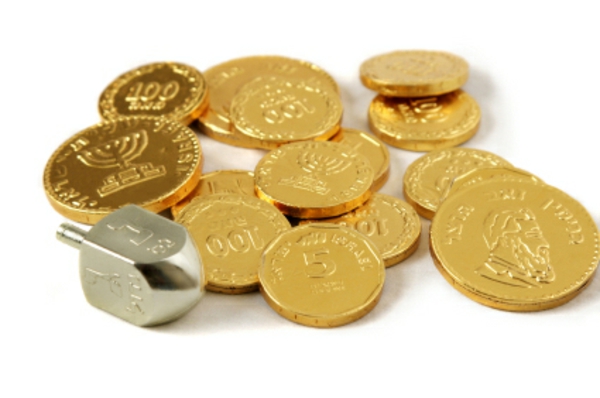
After lighting the menorah, it is customary in many homes to play the dreidel game. The dreidel, or sevivon in Hebrew, is a four-sided spinning top that children play with during Hanukkah. Each side is imprinted with a Hebrew letter. Studying the Torah was outlawed by the Greeks, so the Jew devised the dreidel to camouflage the fact that they were learning. The Jews secretly gathered in caves to study; if the lookout spotted Greek soldiers, the Jews would hide the scrolls and spin tops. The soldiers would leave them alone, thinking they were gambling, not studying.

Foods fried or baked in oil (preferably olive oil) is customary, to commemorate the miracle of the oil keeping the flame alight in the Temple. Traditional foods include latkes (potato pancakes), pontshkes and sufganiyot (jam-filled doughnuts), and bimuelos (fritters).

Usually comprised of small coins, children often receive Hanukkah gelt (‘money’ in Yiddish) as a gift, though grandparents and relatives oftentimes give larger sums. While adding to the excitement, gelt giving teaches a child to increase in charity and good deeds.

While the Jewish community views Hanukah with less religious significance to that of Rosh Hashanah (Jewish New Year), Yom Kippur (Day of Atonement), Sukkot (Feast of Tabernacles), Passover, and Shavu'ot, it is a time for Jews to recall their history and the rededication of the Holy Temple. 

A lichtigin Chanukah (“an enlightened Hanukkah") and chag sameach (“Happy Holiday”) to all!


Wednesday, 19 September 2012

Shanah Tovah: The Tradition of a New Beginning


Sunset of September 25th, 2012 will mark Yom Kippur, the beginning of the holiest and most solemn day of the year for the Jewish population.  This “Day of Atonement”, carries essential themes of atonement and repentance. Often spending most of the day in synagogue services, Jews traditionally observe this holy day with a 25-hour period of fasting and intensive prayer. Yom Kippur completes the annual period known in Judaism as the High Holy Days, which began with Rosh Hashanah at sunset this past Sunday, September 16th, 2012.

Rosh Hashanah, which literally translates to, "head of the year", is the Jewish New Year. It is the first of autumns High Holy Days, also known asthe "Days of Awe".
  Rosh Hashanah is celebrated on the first two days of Tishrei, the seventh month ofthe Hebrew calendar.It is described in the Torah as “Yom Teru'ah”, a day of sounding the shofar, which is traditionally made of a ram’s horn. Rosh Hashanah customs include sounding the shofar and eating symbolic foods such as apples dipped in honey.

Yom Kippur is the tenth day of the month of Tishrei. According to Jewish tradition, G-d inscribes each person's fate for the coming year into the Bookof Life on Rosh Hashanah, and waits until Yom Kippur to "seal" theverdict. During the Days of Awe, the Jewish community tries to amend his or her behaviour and seek forgiveness for wrongs done against G-d (bein adam leMakom) and against other human beings (bein adam lechavero). The evening and day ofYom Kippur are set aside for public and private petitions, and confessions of guilt (Vidui). At the end of Yom Kippur, one considers oneself absolved by G-d.


The Yom Kippur prayer service includes several unique aspects. One is the actual number of prayer services. Unlike a regular day, which has three prayer services, or a Shabbat or Yom Tov, which have four prayer services, Yom Kippurhas five prayer services: Ma'ariv, the evening prayer; Shacharit, the morning prayer; Mussaf, the additional prayer; Mincha, the afternoon prayer; and Ne'ilah, the closing prayer. The prayer services also include a public confession of sins (Vidui) and a unique prayer dedicated to the special Yom Kippur avodah (service) of the Kohen Gadol in the Holy Temple in Jerusalem.


As Yom Kippur is a complete Sabbath; no work can be performed on that day. Additionally, Jews refrain from eating and drinking (even water) on Yom Kippur. It is a complete, 25-hour fast beginning before sunset on the evening before Yom Kippur and ending after nightfall on the day of Yom Kippur. The Talmud also specifies additional restrictions that are less well-known: washing and bathing, anointing one's body (with cosmetics, deodorants, etc.), wearing leather shoes (Orthodox Jews routinely wear canvas sneakers under their dressclothes on Yom Kippur), and engaging in sexual relations are all prohibited onYom Kippur.


As always, any of these restrictions can be lifted where a threat to life or health is involved. In fact, children under the age of nine and women in childbirth (from the time labour begins until three days after birth) are not permitted to fast, even if they want to. Older children and women from the third to the seventh day after childbirth are permitted to fast, but are permitted to break the fast if they feel the need to do so. People with other illnesses should consult a physician and a rabbi for advice.


It is customary to wear white on Yom Kippur, which symbolizes purity and callsto mind the promise that one’s sins should be wiped away.  Some that follow the Jewish faith also believe that humans are compared to angels on this day. It is customary to not wear gold jewellery as gold serves as a reminder of sins associated with the golden calf, a story passed down among the Jewish community.

While the day of Yom Kippur is the most solemn of the year, an undertone of joy suffuses it.
It’s a joy that revels in the spirituality of the day, which expresses the confidence that G-d will accept repentance, forgive sins, and seal a verdict for a year of life, health and happiness. The closing Neilah service climaxes in the resounding cries of "Hear OIsrael... G-d is one."   There is then an eruption of song and dance, followed by a single blast of the shofar. The service is capped with the traditional proclamation: “Next year in Jerusalem." which is then followed by a festive after-fast meal, turning the evening after Yom Kippur into its own festival.

Shanah Tovah (“a good year”) to all of Global Learning’s Jewish family, friends, neighbors and colleagues!


“Peace, peace to the far and to the near! “  - Isaiah 57.19

Tuesday, 11 September 2012

Where Are You Leading Us?

As a society, we have developed the practice of choosing leaders to maintain what we hope will be high-quality efficiency in our workplaces and our communities. The goal of any leader should not only be to always maintain productivity, but to also continuously strive to seek it.  

When political leaders utilize social platforms that seek to remove rights from law-abiding  individuals, I must question: how is this efficient or productive? 

Last Tuesday, the province of Quebec elected Pauline Marois of the Parti Quebecois as the first female premier in its history. My “fellow Canadian female leadership” hat is tipped to her for such an achievement. However, Ms. Marois’ position on diversity has certainly given me pause for concern, as she has wandered into my professional arena.

Marois balanced her victory on a platform that sought - and could potentially succeed in - removing all religious references and attire from all provincial institutions. This would include turbans, head scarves, and even yarmulkes. Excluded from the list of religious symbols: the crucifix, as one hangs at the National Assembly and has been deemed of historical significance.

I’m a big fan of empathy and the act of envisioning the experience of others. 

Imagine this, if you will:

It’s your first day of work with the province of Quebec,where you will answer phone calls from the public at the Attorney General’s office. Upon your arrival, you are greeted by a young man clothed with a turban. He treats you with respect and does everything he can to make sure you feel comfortable on your first day. He even makes it his job to introduce you to the rest of the team. Not once does he ever say anything religious, let alone regarding his own faith. 

Does this man’s turban or actions in any way, shape or form:
    • prohibit you from doing your job?
    • prohibit you from freely expressing yourself?
    • place you in any danger?

      The answer is no.

      Why would a leader such as Pauline Marois seek to oppress personal identities for political gain? 

      What is the point?

      The only point to invoke such laws is to make those who are uncomfortable with difference feel more comfortable.  

      This is unproductive and inefficient.

      Our global history is fraught with examples, teaching us that oppression will only lead us, at best, to short-lived functionality.  There will always be a break in the system caused by the mental strain of resentment. These cracks inevitably carry with them a firestorm of financial loss and extreme emotional damage.

      We cannot, however, sit back and only shake our fists at the leaders we have elected to follow. 

      As constituents of any society we must look at these situations with deep understanding. The more people choose to align themselves with any leader, the louder that leader’s voice becomes.  

      What does this mean? If you choose to follow, promote, vote for a leader who is actively seeking to deny equal rights to any law-abiding individual, you are choosing to promote oppression. 

      This is your right. But what will this do for the future of your community? What lesson will younger generations learn from such actions?

      Say you were invited to three parties on the same evening. Each party has a very specific set of criteria required to attend it.

      With your physical, mental and fiscal well being in mind, which party would you choose?

      The party where:
      • You are welcome as you are, but all that is expected of you is that you abide by the law.  
      • You are welcome, but only if you alter yourself to be similar to everyone else and, if you don’t, it’s against the law.
      • You are not welcome at all. Just being you is against the law.

      I firmly stand for you and your right as an individual to follow whichever leader - and attend whichever party - you feel makes the most sense to your life’s journey.  But you must always recognize the proven dangers when following a leader that seeks to oppress law-abiding citizens.

      Leadership on the grounds of oppression will inevitably result in an outcome that contains fear, tension, and distress.

      I ask again: how is promoting the oppression of law-abiding constituents’ efficient leadership? 

      The answer is and will always be: it’s not.


      “He that would make his own liberty secure, must guard even his enemy from oppression; for if he violates this duty, he establishes a precedent that will reach to himself.” -Thomas Paine